
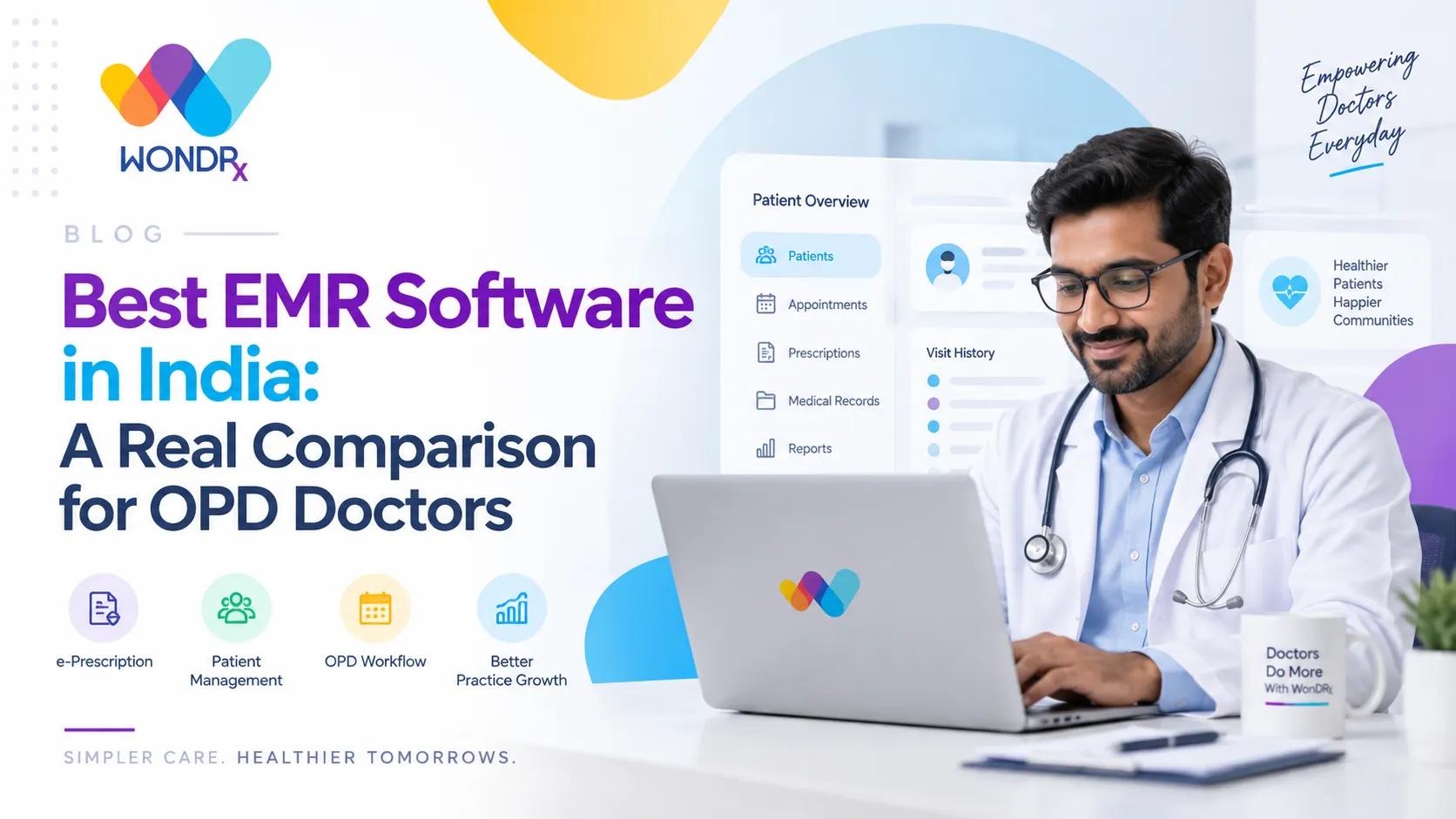
Best EMR Software in India: A Real Comparison for OPD Doctors
Every "best EMR software in India" article reads the same way. A list of five or six tools, each with a bullet-pointed feature set, a star rating pulled from a review site, and a "compare and choose" line at the end. What none of them tell you is whether the software actually survives your Tuesday OPD.
You don't need another feature checklist. You need to know which of these tools will still be open on your desk in week three, after the initial excitement of "we've digitized" wears off and you're back to seeing 40 patients with four minutes each.
So this comparison works differently. We're not ranking by number of features. We're ranking by one question: does this system ask you to change how you already practice medicine, or does it adapt to how you already work? WONDRx is built around the second answer, which is why it leads this list, and we'll also give you an honest, accurate look at where HealthPlix, Doxper, TatvaCare, and ekacare fit for different kinds of practices.
What Actually Makes an EMR "Best" for an Indian OPD
Before the list, it's worth being clear about the test we're applying, because it's different from what most comparisons use.
A high-volume Indian OPD isn't a controlled environment. It's a doctor writing fast, a queue that doesn't stop, and a workflow that was never designed around a keyboard. Any EMR that assumes you'll type symptoms, click through diagnosis dropdowns, or fill structured fields between patients is asking for time that doesn't exist at OPD volumes.
So "best" here means:
Fits the consult, not the demo. Works at the speed you actually see patients, not the speed a sales pitch shows you.
Doesn't require retraining. If a system takes weeks to get comfortable with, it's already losing against the paper pad it's supposed to replace.
Produces clean, structured digital data. Legible, searchable, and ready to plug into ABDM or your own records, without you doing double work later.
Every tool below does some of this. Only one is built to do all three without asking you to change how you write a prescription.
1. WONDRx: The Only EMR That Doesn't Change How You Write Prescriptions
WONDRx is a smart prescription device built on a specific idea: doctors shouldn't have to learn a new interface to get digital records. You write exactly the way you always have, on your usual pad, in your usual shorthand, at your own speed. WONDRx converts that handwritten prescription into a clean, structured digital record in the background.
Why it's ranked first:
Zero behaviour change. No typing, no dropdown menus, no new screen to learn mid-consult. This isn't a smaller learning curve than other EMRs, it's no learning curve.
Built for high-volume OPDs. A 40-patient day with four minutes per consult is exactly the environment WONDRx is designed around, not an edge case it struggles with.
EHR-ready output without the typing tradeoff. You get structured, searchable digital records that are ready for ABDM-linked systems, but the doctor's part of the job never changes.
Better legibility, immediately. Pharmacists and patients get a clean, readable prescription the moment the pen leaves the paper, no re-typing required later.
Where it fits: Solo OPDs, high-volume clinics, and hospital outpatient departments where the biggest barrier to digitization has always been time, not willingness. If your last attempt at an EMR got abandoned because nobody had time to type between patients, this is the gap WONDRx was built to close.
One honest note: WONDRx isn't a full practice management suite with billing, appointment scheduling, and inventory built in. It solves the specific, high-friction problem of getting a doctor's handwriting into clean digital form. For clinics that want that plus the rest of practice management, WONDRx's structured output is designed to feed into whichever EMR or EHR system you're already using.
3. HealthPlix: Feature-Rich AI EMR for Practices Ready to Type
HealthPlix is one of the most widely adopted EMR software in India, and it leans heavily into AI-assisted, fast data entry rather than handwriting conversion.
Standout features:
Positions itself as fast Rx-writing software, claiming prescriptions can be written within 30 seconds through its structured interface.
Supports 16+ medical specialties and can print prescriptions in 14 regional languages.
Offers a mobile app (HealthPlix SPOT) with teleconsultation, automated patient reminders, and the ability to send digital prescriptions over text or WhatsApp.
Includes an analytics layer (ROBIN) with a doctor-facing dashboard for tracking patient visit trends and follow-up insights.
Where it fits: Doctors and clinics comfortable adopting a structured, click-and-select workflow in exchange for AI-assisted speed, strong analytics, and multi-language prescription support.
Worth knowing: Even at "30 seconds," HealthPlix's core workflow still runs through screen-based data entry, selecting from fields, templates, and dropdowns, rather than converting handwriting. That works well for doctors who are already comfortable typing during consults; it's a harder sell in an OPD where even a few seconds per field adds up across 40+ patients.
4. TatvaCare: ABDM-Certified All-in-One Platform
TatvaCare, marketed under TatvaPractice, positions itself as a broad all-in-one platform covering EMR, practice management, and patient engagement in a single system.
Standout features:
Uses AI features like VoiceRx and SmartSync, which aim to simplify medical documentation and reduce administrative workload, alongside configurable specialty-specific EMR templates.
ABDM-certified and ABHA compliant, positioned as part of India's national digital health framework.
Includes lab test ordering, digital prescriptions, and automated follow-up reminders within the same platform.
Bundles a broader ecosystem beyond the core EMR, including a medical knowledge base, specialty news updates, and an AI differential-diagnosis assistant.
Where it fits: Practices that want one platform handling EMR, clinic management, patient education content, and continuing medical updates together, and that are comfortable with a feature-dense, all-in-one system.
Worth knowing: User reviews point to inconsistent customer support as a real friction point, and a platform this broad usually comes with a steeper setup and onboarding curve than a narrowly focused tool. If your clinic mainly needs prescription digitization without the extra layers, TatvaCare may be more platform than you need.
5. ekacare: AI Documentation With a Consumer Health Ecosystem
ekacare has grown into one of the larger EMR software in India, combining doctor-facing tools with a consumer health app used by patients directly.
Standout features:
Trusted by over 25,000 doctors, with customizable templates, medical calculators, dental and vaccination charts, and real-time revenue tracking.
EkaScribe adds voice-based documentation, aiming to automate clinical note-taking so doctors spend less time typing.
Prescription pad can be customized by specialization, and the platform supports WhatsApp integration for sharing prescriptions and reminders directly with patients.
FHIR-compliant and ABDM-aligned, with the stated aim of reducing manual clerical work and improving continuity of care through structured, connected data.
Where it fits: Clinics that want an EMR tied into a larger consumer health ecosystem, where patients can also access their own records, self-assessments, and health tracking through the same platform.
Worth knowing: ekacare's core prescribing flow is still largely screen and template-based, with voice dictation (EkaScribe) as the main alternative to typing. Voice-based documentation is a genuine step forward for some doctors, but it still requires you to actively dictate structured notes during or after a consult, which is a different behaviour than the one you've built over years of handwriting prescriptions.
Why "Best" Should Mean "Actually Gets Used"
Here's the pattern that repeats across Indian OPDs, and it's the real reason this list is ordered the way it is. Clinics buy an EMR, run a pilot, and within weeks the doctor is back to a paper pad because typing between patients simply isn't realistic at OPD volumes. The software wasn't wrong about its features. It was wrong about who it was built for.
Doctors don't resist digitization. They resist tools that ask them to change how they practice medicine just to produce a digital file. That's the filter worth applying to every name on this list, including WONDRx: not "what can it do," but "will I still be using this in three months, at full patient volume, without a single dropped consult."
Book a demo with WONDRx and see how a handwritten prescription becomes a digital one, without changing anything about how you practice.